NRR Is the Only SaaS Metric That Actually Matters Now
churn and retention data analytics growth analytics MRR analytics saas metrics SaaS analytics
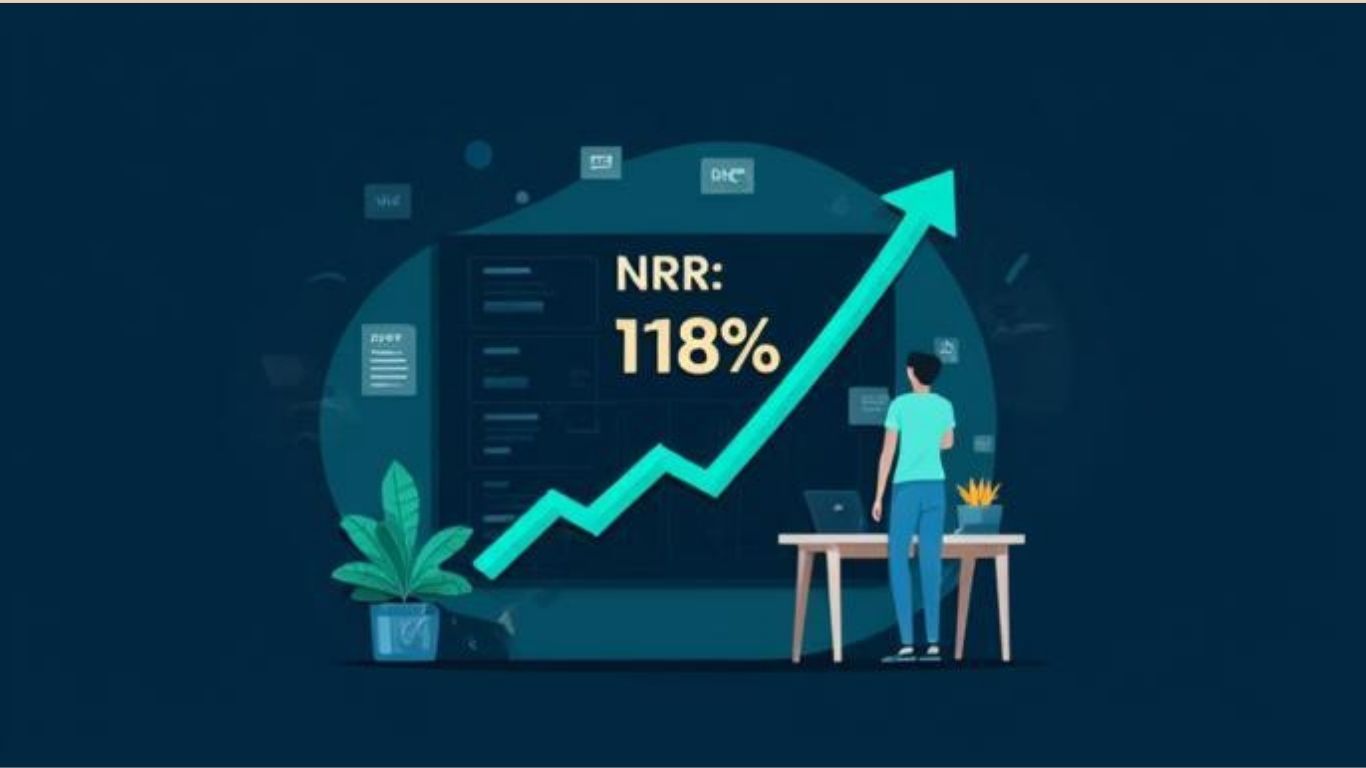
There's a metric that's been quietly separating the serious SaaS companies from everyone else for the last two years.
It's not MRR growth. Not DAU/MAU ratios. Not conversion rate. Those numbers matter, but they'll get you to a certain point and then stop telling you the truth.
Net revenue retention — NRR — is the one. A McKinsey analysis of over 100 B2B SaaS companies found that top-quartile performers on NRR trade at a median of 24x EV/Revenue, while bottom-quartile peers sit at 5x. That's not a small gap. That's a valuation story being written entirely by a single metric. If you're a founder and you're not obsessing over this number yet, start now.
What NRR Actually Is (And What It's Not)
Net revenue retention SaaS measures how much revenue you keep and grow from your existing customer base over a set period. Usually 12 months. It accounts for expansion (upgrades, upsells, seat growth), contraction (downgrades), and churn. If you hit 100%, you're flat from existing customers. Above 100%, you're growing from within. Below 100%, you're losing ground before you've acquired a single new customer.
The median across B2B SaaS right now is around 106%. Top performers run 120% or higher. What that means practically: companies above 120% are generating meaningful revenue growth from customers they already have, without depending entirely on acquisition.
Here's what NRR is not. It's not a customer success vanity metric. It's not something to check quarterly and then forget about. It's a direct reflection of whether your product is delivering enough value that customers want more of it. Or less.
Why It Matters More Now Than It Did Three Years Ago
The environment changed. Growth at all costs is done. Cheaper capital isn't coming back fast enough to make burn-rate-funded acquisition loops viable for most companies. What's left is making the most of the customers you already have.
Expansion revenue now drives 38% of new ARR for companies over $25M in ARR, up from 27% in 2022. That number isn't going back down. The maths of SaaS has shifted. Acquisition costs are high. Existing customers, if they're healthy, are the best growth engine available.
"NRR is where everything converges," says Ian Naylor, Founder of SaaSAnalytics.ai. "Activation, retention, expansion - it all lands in that one number. If your NRR is soft, something upstream is broken. The tricky part is figuring out which thing."
That 'which thing' question is where most teams struggle. NRR tells you there's a problem. It doesn't tell you where the leak is.
The Behaviour Data Question
This is where analytics comes in - and where a lot of teams have a real gap.
NRR is the outcome. Behaviour data is the signal. The teams with strong NRR aren't just lucky. They've built visibility into what healthy customers actually do, what they adopt first, which features correlate with expansion, and which usage patterns tend to appear before a downgrade. When those signals are visible and acted on, NRR improves. It's not magic.
SaaS companies that personalise engagement based on user behaviour reduce churn by up to 40%, which directly feeds into NRR. Churn reduction is contraction prevention. Expansion depends on customers reaching value that makes them want more. Both of those are downstream of what's happening in the product.
Most teams are missing that data. Not because it doesn't exist — it does. Because it's not organised in a way that makes it usable. See also: Why Your Churn Rate Is Lying to You.
Becky Halls, Strategist at SaaSAnalytics.ai, has a direct take on this: "The difference between SaaS teams with 115% NRR and 95% NRR usually isn't product quality. It's whether they know what their customers are actually doing. Good NRR is built on that visibility."
Seeing the behaviour clearly is the first step. Acting on it is the second. Most teams are still on step one - or haven't started.
Three Behaviours That Predict NRR Direction
Not all usage data is created equal. There are specific patterns that tend to show up before NRR improves or deteriorates. None of this is universal, every product is different, but these are common enough to pay attention to.
Feature breadth. Customers using more of your product are harder to churn. Not just more active. More spread across features. Single-feature dependency is a contraction risk.
Team adoption. An account where one person is using the tool is far more vulnerable than one where adoption has spread. Seat expansion and broad team usage tend to precede revenue expansion.
Return frequency. How often customers come back matters more than session length. Regular, habitual use is what you want. Infrequent bursts followed by quiet periods are a warning sign.
These patterns need to be visible to act on. If you're tracking them, you can segment by health and intervene early. If you're not, you're looking at NRR after the fact. That's the activation gap problem extended into the full customer lifecycle - not just onboarding.
What the High Net Revenue Retention SaaS Companies Do Differently
High net revenue retention SaaS teams don't chase NRR directly. They build the conditions that make it an outcome.
Specifically: they know what good looks like inside the product, and they have systems that flag when customers drift from it. Their customer success conversations are based on actual product data, not self-reported status. They identify expansion opportunities from behaviour - a team that's hitting feature limits, a power user who's started exploring advanced functionality — rather than waiting for renewal conversations.
"The companies I see consistently above 110% NRR have one thing in common," says Jason Lemkin, founder of SaaStr. "They treat expansion as a product problem, not a sales problem. The product creates the conditions. Sales closes them."
That framing is useful. If expansion requires a heavy sales motion every time, it's inefficient and it'll cap out. If the product creates natural expansion moments - visible to the team, triggered by actual behaviour - it compounds.
A Note for Smaller Teams
You don't need a 20-person CS org to move NRR. Smaller teams often move it faster because they're close enough to their customers to actually act on signals.
What you do need: visibility into what customers are doing, and a lightweight system for flagging accounts that are drifting or expanding. That doesn't have to be complicated. It does have to exist.
Most small SaaS teams are still looking at account-level MRR and manually checking in on customers who went quiet. That works up to a point. After that, it doesn't scale and things fall through the gaps.
FAQ
Q. What's a good NRR for an early-stage SaaS company?
A. The benchmarks vary by stage, but 100%+ is the general target. Below 100% means you're losing revenue from existing customers before acquiring anyone new, which makes growth very expensive. At very early stages, even 95% can be acceptable if you're still finding product-market fit — but it's something to fix quickly.
Q. How often should we measure NRR?
A. Quarterly is the typical cadence for a proper calculation, but many teams track leading indicators (usage, feature adoption, support volume) monthly or weekly. NRR is a lagging metric. The leading signals need more frequent attention.
Q. Does NRR include new customers?
A. No. NRR is calculated on customers who were paying at the start of a period, measured against what those same customers generate at the end of it. New customers acquired during the period are excluded.
Q. What's the difference between NRR and GRR?
A. Gross revenue retention (GRR) only accounts for churn and contraction - it caps at 100%. NRR includes expansion, which is why it can exceed 100%. GRR tells you how well you're keeping revenue. NRR tells you how well you're keeping and growing it.
Q. Can small SaaS companies have strong NRR?
A. Absolutely, and some of the best NRR numbers belong to small, focused products with tight customer relationships and clear expansion paths. Size doesn't determine NRR. Product value and visibility into customer health do.