AI Onboarding for SaaS: Stop Losing Two-Thirds of Your Signups in Week One
AI analytics funnel analytics funnel analytics for SaaS behaviour analytics attribution for SaaS SaaS email automation SaaS attribution SaaS analytics subscription analytics user behavior analytics user journey analytics ai powered analytics churn and retention
You worked hard for that signup. Months of content, an ad budget, a demo, a free trial offer, a landing page you rewrote four times. They signed up. And then, for most of them, nothing. They poked around, didn't get it, closed the tab, and never came back. You'll never even see why.
That's the part that stings. The hardest dollar in SaaS is the one you spend acquiring someone, and most teams hand that person a generic welcome tour and hope for the best.
It doesn't have to go like that.
Most signups never become users
Here's the baseline: The average activation rate for SaaS products sits around 37%. So roughly two out of three people who sign up never reach the point where your product actually clicks. They paid you nothing. They cost you everything to get.
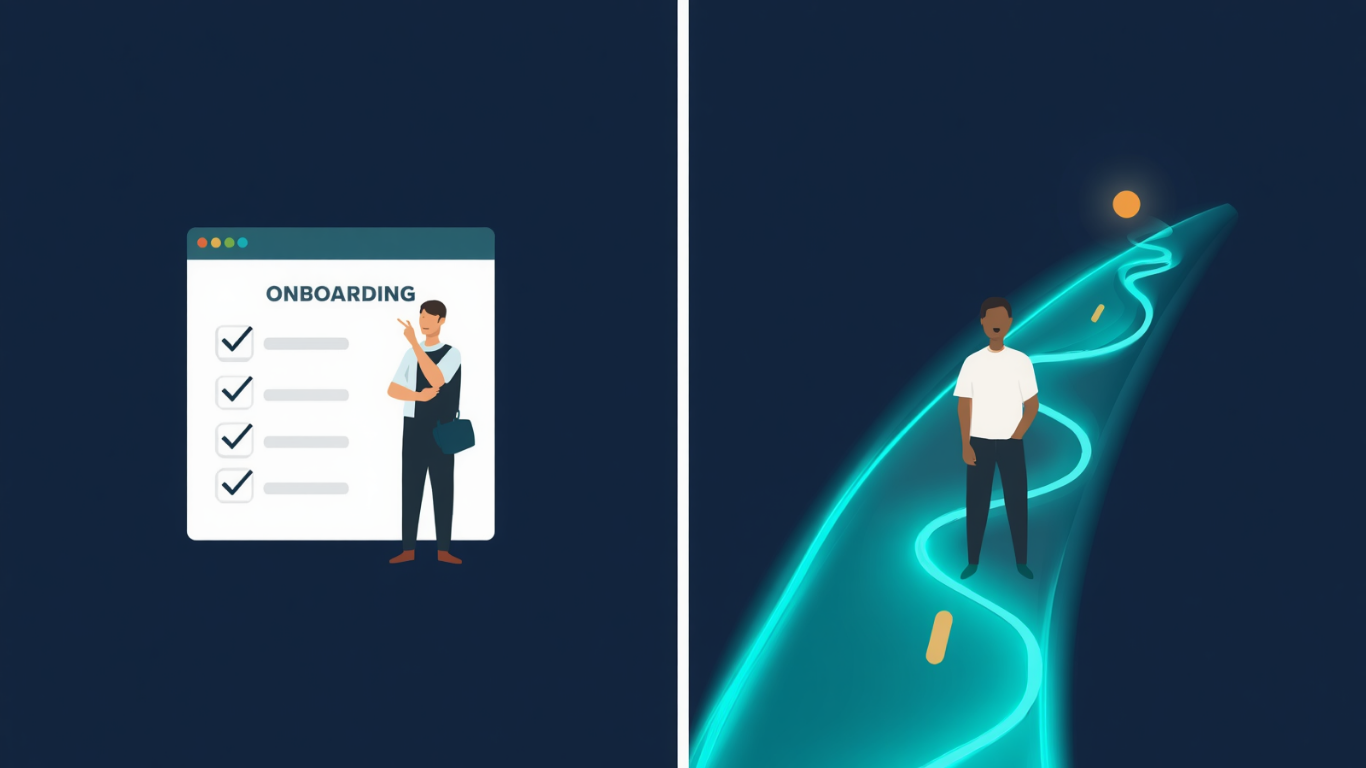
And the standard fix makes it worse. A linear checklist. A five-step tour that fires the same way for a solo founder and a 200-person team. Tooltips pointing at buttons nobody asked about. The user wanted to solve one problem. You gave them homework.
Onboarding broke when it became a script," says Becky Halls, Strategist at SaaSAnalytics.ai. "Every user gets the same five steps regardless of what they're trying to do. It's like a shop assistant who follows you around reading from a card while you're clearly looking for one specific thing. People don't want a tour. They want the answer they came for.
The answer they came for. That's the whole game.
What AI onboarding actually does differently
Forget the buzzword version. The real difference is simple. Static onboarding talks. AI onboarding listens, then responds.
It watches what a user actually does in their first session, then changes what happens next based on that behaviour. Someone who connected their data on minute one gets pushed straight to the advanced feature that'll hook them. Someone who's clearly stuck on step two gets help right there, before they rage-quit. The flow bends to the person instead of dragging every person through the same tunnel.
The numbers back this up, and they're not small. Personalised onboarding has been shown to lift retention by up to 40% and day-30 retention by as much as 52% versus generic flows. Read that again. Same product, same signups, dramatically different outcome, purely from reacting to what people do.
Static onboarding assumes you know what every user needs before they arrive," says Ian Naylor, Founder of SaaSAnalytics.ai. "You don't. Nobody does. The product should figure out what this specific person is trying to achieve and clear the path to it. That's not a fancier tour. It's the difference between guessing and watching.
Watching beats guessing. Every time.
The thing onboarding is really fighting
Underneath all of this sits one number that decides everything: how fast users reach real value. Hit that moment quickly and they stay. Miss it in the first session or two and you've likely lost them, whatever your renewal date says.
Generic onboarding ignores this. It walks everyone through your feature list at the same pace, when what each user needs is the shortest possible line to their own "oh, I get it now." For one person that's importing data. For another it's seeing a teammate's activity. AI onboarding finds that moment per user and runs straight at it.
This connects to the activation gap quietly killing your growth, the silent space between "signed up" and "actually using it." Most products have a much bigger gap than they think, because they measure signups and revenue but skip everything in between. That middle is where users are won or lost, and it's the part a script handles worst.
A product growth lead we spoke with framed it well: "Acquisition gets all the budget and all the dashboards. Activation gets a checklist somebody built in 2021 and never touched again. That's backwards, and the teams figuring it out are eating everyone else's lunch." [Note: external quote is a placeholder. Confirm attribution or swap for a sourced quote before publishing.]
Backwards is fixable. But only if you can see it.
Here's a pattern we see constantly. A team ships a slick five-step tour, watches completion rates, and feels good because 70% "finish" it. Then they check retention and it's flat. The tour got completed and the product still didn't land. Why? Because finishing a tour and reaching value are different things, and the tour measured the wrong one. People clicked "next" four times to make the popup go away. That's not activation. That's politeness. The teams who switch to reacting to real behaviour stop celebrating tour completion and start watching what users do with no popup in sight.
You can't personalise what you can't see
Here's the catch, and it's why most teams never get AI onboarding off the ground. To react to behaviour, you have to capture behaviour first. Cleanly. In real time. In one place.
That's the gap SaaSAnalytics.ai closes. One JavaScript snippet on your site tracks what every user does from their first anonymous visit onward. The same data that shows you where people get stuck is the data that fires the right nudge at the right second, automatically. No exporting CSVs into a separate tool. No stitching three platforms together and praying the user IDs match. Behaviour, triggers and support share one dataset, so onboarding can actually respond to reality instead of a guess.
That means you can do the useful things on day one. Spot the step where signups stall. Trigger help the moment someone hesitates instead of a day later. Route power users to depth and confused users to a hand. Watch your activation rate climb because the product finally meets people where they are.
See it on your own users
You don't have to take any of this on faith, which is the point. Reading about activation rates is one thing. Watching your own signups move through a flow that reacts to them is another.
There's a 30-day free trial, no credit card needed. Drop the snippet on one project and you'll start seeing real behaviour from your real users within minutes, not weeks. Start a free trial and point it at your worst onboarding step, the one you already suspect is leaking people. See what's actually happening there. Then fix it while the user's still in the room, not three emails too late.
That signup you fought for deserves better than a tour. Give it one.
FAQ
What is AI onboarding for SaaS? It's onboarding that adapts to each user's behaviour in real time instead of running the same fixed sequence for everyone. The product watches what someone does, works out what they're trying to achieve, and adjusts the next step to clear the path to it.
How is it different from a normal onboarding checklist? A checklist is the same for everyone and ignores what the user actually does. AI onboarding reacts, sending stuck users help and advanced users depth. One is a script that talks at people. The other responds to them.
Does personalised onboarding really improve retention? The published numbers are strong. Personalised flows have lifted retention by up to 40% and day-30 retention by as much as 52% compared with generic onboarding. The mechanism is simple: people who reach value fast tend to stay.
Why do so many SaaS signups never activate? The average activation rate is around 37%, so most signups drift off before the product clicks for them. Usually it's because generic onboarding makes them work for value instead of delivering it quickly, and nobody's watching where they get stuck.
Do I need a developer to set this up? Setup is one JavaScript snippet on your site, so it's light. You start collecting behavioural data within minutes, and you can run it on a single project alongside your existing tools before committing to anything.
How do I try AI onboarding without paying? SaaSAnalytics.ai has a 30-day free trial with no credit card required. Add the snippet to one project, watch your real users move through onboarding, and find the steps where they stall. If it doesn't show you something useful, you've spent nothing but a few minutes.