At Some Point, Every SaaS Outgrows Its Analytics Stack
AI analytics analytics platform funnel analytics product analytics startup analytics user journey analytics

Most SaaS products don’t fail because the idea is bad. They fail because the signal gets lost.
We’ve been there ourselves.
You launch with momentum. Early users come in. Data starts flowing. You add tools to answer one question, then another, then another. Before you know it, you’ve got plenty of numbers but very little confidence.
At some point, you catch yourself staring at dashboards thinking, “I still don’t know what I should do next.”
That exact moment is why SaaSAnalytics exists.
Not to add another layer of analytics. Not to generate prettier charts. But to give founders a calmer, more connected view of what’s actually happening inside their product - and to make decisions feel grounded again.
This article covers the foundations of SaaSAnalytics. What it does, how it works, what it can replace, and why it’s built the way it is. This isn’t a feature dump. It’s the thinking behind the platform.
The Real Problem We Kept Running Into
Early on, we assumed the issue was a lack of data.
It wasn’t: We had Google Analytics. Stripe dashboards. Product analytics. Support tools. Automations firing in the background. On paper, everything was 'tracked'.
But when we asked simple questions like:
- Why are these users converting and those ones not?
- What actually caused churn last month?
- Which changes genuinely moved the needle?
The answers were a little fuzzy.
The data existed, but it lived in silos. Nothing told a single, coherent story.
That’s when it clicked for us. The problem wasn’t visibility. It was fragmentation.
SaaSAnalytics was built to solve that specific pain.
What SaaSAnalytics Is (From a Founder’s Perspective)
Technically, SaaSAnalytics is a unified analytics, attribution, automation, and AI platform for SaaS businesses.
Practically, it’s the place we go when we want to sanity-check a decision.
It’s the system that answers:
- “Is this channel actually worth the effort?”
- “Are users doing what we think they’re doing?”
- “Did that feature launch matter?”
- “What changed before revenue dipped?”
We didn’t want another specialist tool. We wanted a control layer that sat across the whole journey, from first visit to long-term usage.
That’s what SaaSAnalytics is designed to be.
Why Everything Starts With Projects
One of the earliest decisions we made was to structure SaaSAnalytics around projects, not accounts. This came directly from experience.
We rarely run one thing at a time. There’s a main product, a side product, an experiment, maybe a client platform. Traditional analytics tools make this awkward.
With SaaSAnalytics, each project is self-contained, but visible from the same top-level view. When you’re juggling multiple products, that matters more than you think. It changes how often you check in, how quickly you spot problems, and how confident you feel moving attention around.

Setup Should Never Be the Hard Part
We’ve abandoned more tools than we care to admit because setup felt like work we didn’t need.
That’s why SaaSAnalytics uses a single tracking script and keeps configuration minimal.
Once it’s in place, you can track:
- Sessions and users
- Traffic sources and UTMs
- Devices, locations, referrers
- And the events that actually mean something for your business
The guiding principle here was simple: If you need a consultant just to get useful data, something’s wrong.
Metrics That Reflect How You Actually Run Your SaaS
This is one area where we changed direction mid-build. Originally, we leaned more heavily into charts and graphs. They looked good. They also slowed decision-making.
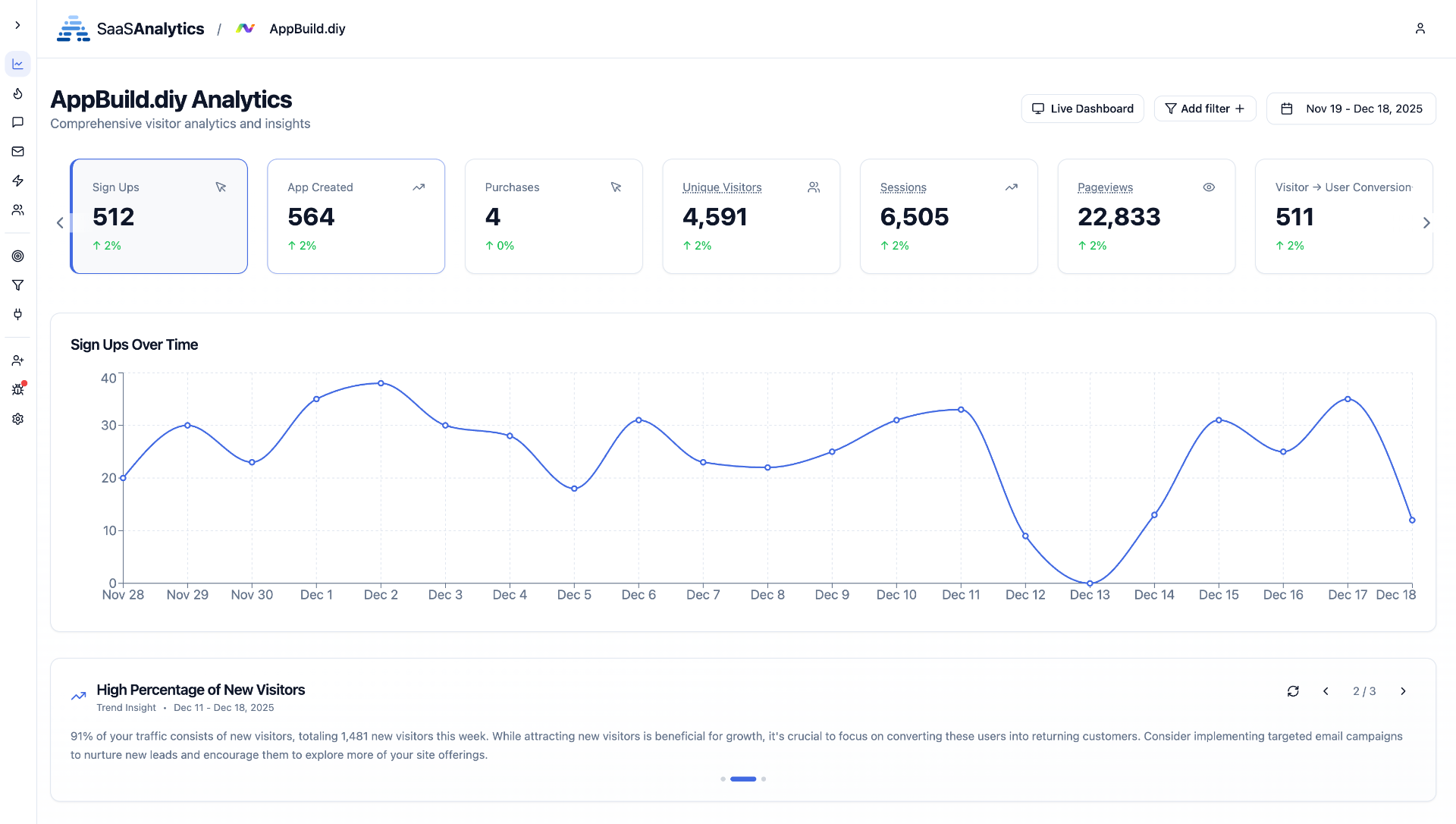
What we actually needed, day to day, were clear numbers tied to outcomes. That’s why the main dashboard uses metric tiles.
They answer questions quickly:
- Are signups up or down?
- Are people reaching the key action?
- Are trials converting?
- Is usage healthy?
Some metrics are standard. Others are fully custom. We’ve learned that founders chasing the wrong north star is often a tooling problem, not a strategy one.

Attribution: Where Our Assumptions Broke
Attribution is where SaaSAnalytics surprised us the most.
Like most teams, we assumed certain channels were 'working' because they drove traffic. Once we connected traffic to behaviour and revenue, that confidence started to wobble. Some channels looked great on the surface and quietly underperformed. Others brought fewer users but far better ones.
SaaSAnalytics tracks traffic sources, UTMs, and referrers, then follows users through activation, trials, and payments.
Seeing that full chain changes how you think about marketing. We’ve reallocated effort more than once after looking at this data.
Funnels That Don’t Pretend Users Are Robots
We’ve never seen a real user journey that looked like a clean marketing funnel.
People jump around. They leave. They come back. They ignore the thing you thought was obvious.
SaaSAnalytics funnels are built around behaviour, not assumptions.
You define the steps that matter. The platform shows you where people pause, where they drop off, and how long things actually take.
We’ve used this repeatedly to stop guessing where friction lives.

Stripe Data, Finally Telling a Story
Stripe is excellent at reporting payments but it’s not great at explaining them.
By pulling Stripe data directly into SaaSAnalytics, revenue stops being an isolated outcome and starts becoming part of a wider narrative.
This is where things get uncomfortable in a useful way...
You can see patterns you didn’t expect. Features you assumed were 'core' sometimes aren’t. Behaviours you didn’t value enough often are.
It’s one of the most grounding parts of the platform.
Automation That Doesn’t Feel Like Spam
We’ve all built automations that technically worked but didn’t feel right. The issue is usually context.
In SaaSAnalytics, automations are triggered by real usage, not arbitrary rules. Events, inactivity, funnel behaviour, Stripe signals.
That means messages arrive when they make sense.
We’ve found this leads to fewer automations overall, but better ones.

Where AI Actually Helps
We’re cautious with AI. Not because it isn’t powerful, but because it’s easy to overdo it.
Inside SaaSAnalytics, AI is used sparingly:
- To surface patterns that would otherwise get missed
- To help users get answers inside the product without friction
The AI chat widget is trained on your actual content. When it can’t help, it hands off cleanly.
In practice, this has reduced repetitive support questions and smoothed onboarding without removing the human layer.
What We’ve Replaced Ourselves
We didn’t set out to replace tools. It happened naturally.
Over time, we reduced reliance on:
- Google Analytics
- Intercom
- Customerly
- Large chunks of product analytics platforms
- Attribution tools
- Internal reporting spreadsheets
- Some onboarding and support workflows
The biggest benefit wasn’t cost saving. It was mental load.
When there’s one place to check the truth, decisions get easier.
Who SaaSAnalytics Is Really For
SaaSAnalytics tends to resonate with founders who:
- Are past the early chaos phase
- Want to understand cause and effect
- Feel the pain of tool sprawl
- Care about clarity more than complexity
If you enjoy deep analytics configuration for its own sake, this probably isn’t for you.
If you want fewer assumptions and better calls, it usually is.
Why This Foundation Matters
We didn’t build SaaSAnalytics to be exciting.
We built it to be reliable.
It’s the place you go when something feels off. The place you check before reacting. The place that helps you move with intent instead of instinct.
That’s the foundation.
Everything else builds on it.